

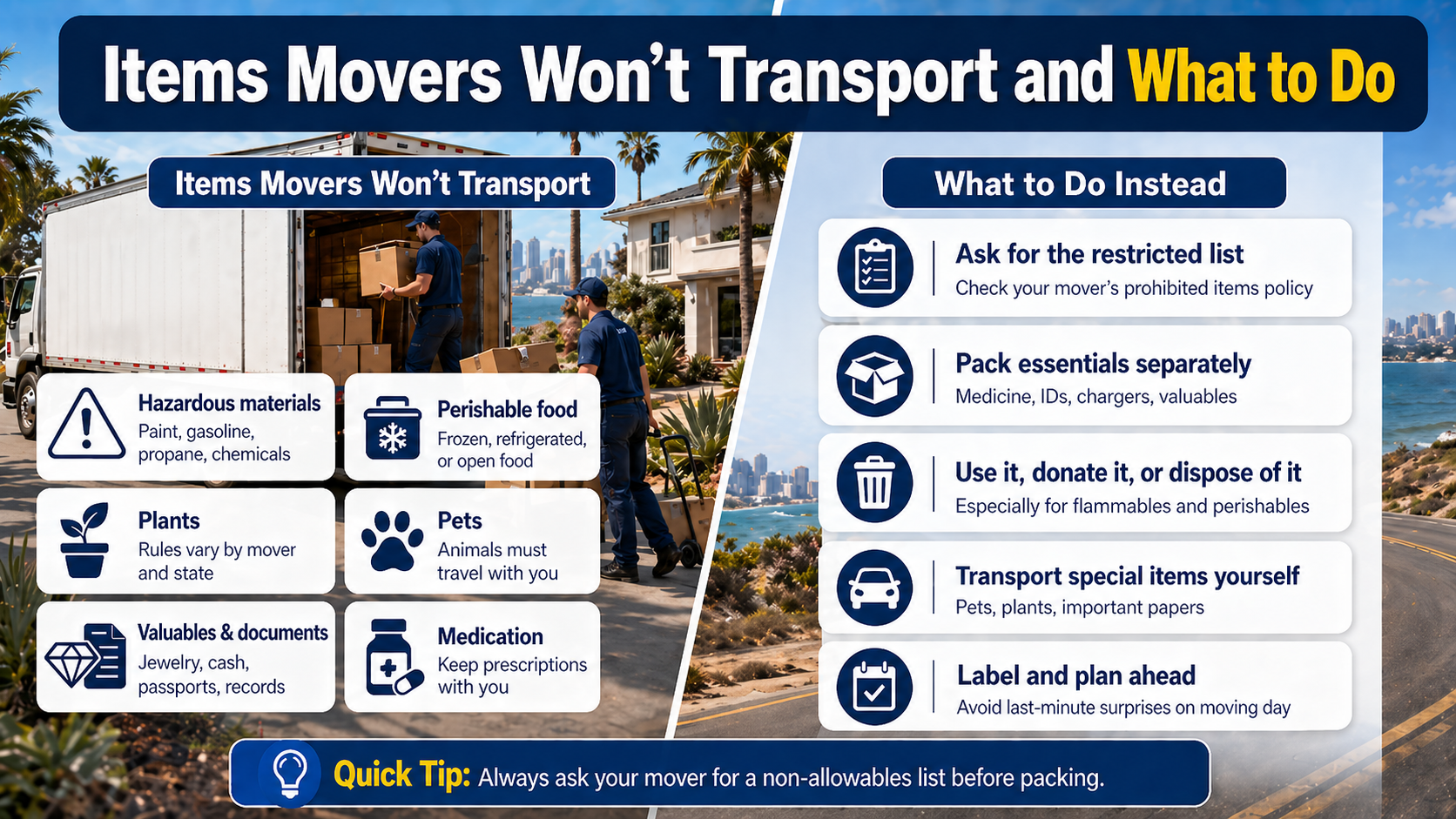
Discovering on move day that several of your belongings can’t go on the truck is one of the most stressful surprises a relocation can throw at you — and it happens more often than people expect. Knowing about items movers won’t transport and what to do about them before you start packing is one of the smartest things you can do to keep your San Diego move on schedule and on budget.
Every professional moving company maintains a Non-Allowable Items list — a set of goods that cannot be loaded onto the moving truck under any circumstances. These restrictions exist for safety, regulatory, and liability reasons, and they apply regardless of how carefully an item is packed. The good news is that most prohibited items have straightforward alternatives, as long as you plan ahead.
Movers Refuse Hazardous Materials Because of Federal Safety Regulations — Not Personal Preference
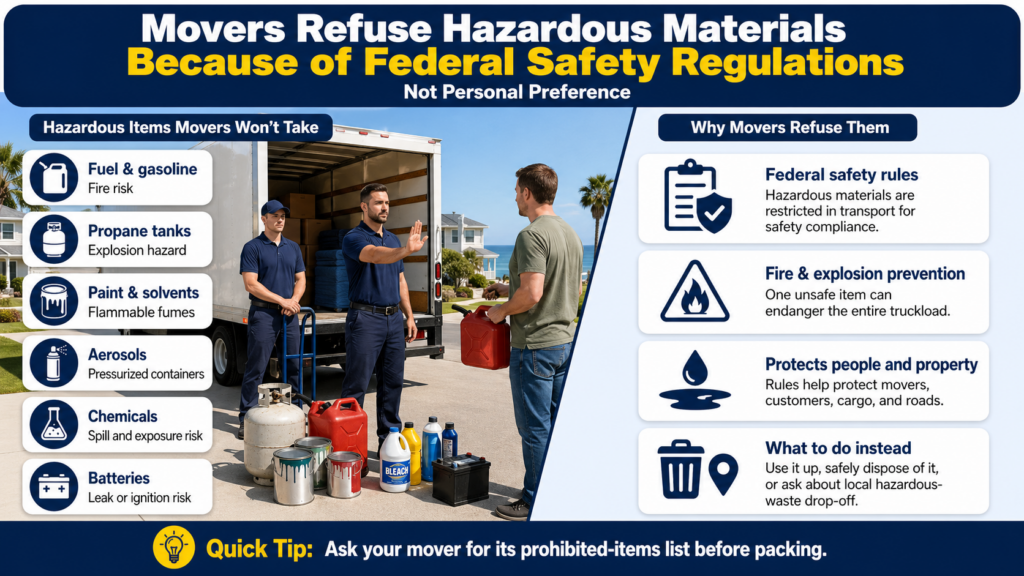
The restrictions movers place on certain items aren’t arbitrary. Moving trucks are regulated by the U.S. Department of Transportation, and carriers that transport hazardous materials without proper certification face serious legal penalties. More practically, flammable, explosive, or corrosive materials on a loaded moving truck pose a genuine safety risk to your belongings, the crew, and other drivers on the road.
The broad categories of hazardous items that professional movers — including Chief Moving Company — will not transport include:
- Flammable liquids and gases: gasoline, propane tanks (even “empty” ones), lighter fluid, kerosene, and acetone
- Compressed gas cylinders: oxygen tanks, helium tanks, and CO2 canisters
- Corrosive chemicals: pool chemicals, acids, drain cleaners, and industrial solvents
- Explosive materials: fireworks, ammunition, and gunpowder
- Paints and stains: oil-based paints, paint thinners, and lacquers (water-based latex paint is sometimes allowed — confirm with your mover)
- Pesticides and fertilizers: insecticides, herbicides, and chemical fertilizers
These aren’t edge cases. Most households have several of these items in the garage, under the sink, or in the garden shed — and most people don’t think about them until the truck has already arrived.
These Are the Most Common Non-Hazardous Items Movers Won’t Take Either
Beyond chemicals and flammables, there’s a second category of items that movers typically refuse for reasons that have less to do with safety and more to do with liability, regulation, and practicality. Being aware of these before you start packing can prevent last-minute scrambling.
Perishable Food and Open Pantry Items
Movers will generally decline to transport open food packages, refrigerated items, and anything that could spoil during transit. Temperature-controlled transport isn’t something standard moving trucks provide. For a local San Diego move completed in a day, you may be able to pack and transport sealed, non-perishable food yourself — but for long-distance moves, it’s best to plan to use up, donate, or discard pantry items before your move date.
Plants
Live plants are a complicated case. Many movers won’t take them at all because they can be damaged easily, attract pests, and soil spills inside a truck can damage other items. For interstate moves, California has strict agricultural regulations that restrict bringing certain plants across state lines in either direction. If you’re moving out of California, check with the destination state’s Department of Agriculture before attempting to bring plants along.
Pets and Live Animals
No professional moving company will transport pets, fish tanks with live fish, or any other living animals. This applies universally, regardless of how the animals are contained. You’ll need to arrange separate pet transportation — whether that means taking them in your own vehicle, booking a pet transport service, or flying them as cargo.
Valuables and Irreplaceable Documents
Most reputable movers — Chief Moving included — strongly recommend that you personally transport items like:
- Cash, checkbooks, and financial documents
- Jewelry, watches, and heirlooms
- Passports, birth certificates, and Social Security cards
- Prescription medications
- External hard drives and devices with sensitive personal data
Even when a moving company is fully insured, claims processes take time, and replacing irreplaceable items isn’t possible. The safest move is to keep these with you directly.
Large Lithium Battery Devices
Electric bikes, electric scooters, hoverboards, and some power tools with large lithium-ion battery packs may be refused depending on the carrier and the length of the move. Lithium batteries have a documented fire risk in enclosed spaces, especially when damaged. If you own any of these items, confirm with your moving company well in advance.
What to Do with Items Your Mover Won’t Take
The fact that your moving company can’t transport something doesn’t mean you’re stuck. Every category of non-allowable items has a practical solution — it just requires a little planning before move day.
Hazardous Materials: Dispose Responsibly
San Diego County operates several Household Hazardous Waste (HHW) collection sites where residents can drop off paints, chemicals, propane tanks, pesticides, and other hazardous materials free of charge. These events run regularly throughout the year — checking the County of San Diego’s Department of Environmental Health website will show you the nearest location and upcoming dates.
Flammable Liquids: Use Up or Give Away
Partially full gasoline cans can be used in your lawn equipment or vehicle before move day. Lighter fluid and charcoal can be offered to neighbors. Propane tanks connected to grills should be fully emptied and, if small, can often be exchanged at hardware stores. Larger tanks may need to be depressurized by a certified professional before disposal.
Food: Donate or Pack Yourself
San Diego has an active network of food banks that accept sealed, non-perishable donations — including the Jacobs & Cushman San Diego Food Bank. Plan a donation drop-off in the week before your move. For pantry items you want to keep, pack them in a box you’ll personally transport in your own vehicle on move day.
Plants: Transport Yourself or Rehome
For a local San Diego move, transporting your plants in your own car is usually the easiest solution. For long-distance moves, consider gifting plants to friends, neighbors, or colleagues. Large potted plants that can’t travel can be donated to community garden programs or left for the next residents with a note.
Valuables: Take Them With You
Set aside a dedicated bag or box for valuables, documents, and medications at least a week before your move. Label it clearly and keep it in your personal vehicle — not on the moving truck. This is one of the simplest and most effective ways to protect yourself from loss or claim disputes.
How to Get Your Mover’s Full Non-Allowable Items List Before Move Day
The best time to learn what your moving company won’t transport is when you book — not when the truck pulls up. Here’s how to approach it:
- Ask directly at booking: Request a written copy of the company’s Non-Allowable Items list. Any reputable mover will have one and should share it willingly.
- Walk through your home in advance: Do a room-by-room check of your garage, laundry room, kitchen, and bathrooms — these are the most common places prohibited items are stored.
- Flag specialty items early: If you have propane-powered equipment, large battery devices, an aquarium, or unusual items, mention them when you request your quote so nothing is a surprise on move day.
- Confirm for long-distance moves: Interstate moves have additional restrictions beyond what applies to local moves. If you’re relocating out of San Diego to another state, ask specifically about any state-specific restrictions at your destination.
At Chief Moving Company, we walk every client through the process during the quoting stage so there are no surprises when our crew arrives. Our team is trained to flag potential issues early and help you find the right solution for every item we can’t transport.
Frequently Asked Questions About Items Movers Won’t Transport
Can movers transport firearms and ammunition?
Ammunition is considered a hazardous material and cannot be transported on a standard moving truck. Unloaded firearms may be transported in some cases, but regulations vary by state and carrier. For moves involving firearms, it’s best to transport them yourself in a locked, hard-sided case, and to comply with the transport laws of every state you’ll pass through. Always confirm with your moving company and review applicable federal and state laws before move day.
Are there items movers won’t take even if they’re properly packed?
Yes. Proper packing doesn’t change the non-allowable status of hazardous materials, live animals, or perishables. The restriction is on the item itself, not how it’s contained. For example, a propane tank sealed in bubble wrap and a labeled box is still a propane tank — it cannot go on the truck regardless of how it’s packaged.
What happens if a prohibited item is found on the truck after loading?
If a non-allowable item is discovered after the truck is loaded, the moving company is within their rights to remove it before departure. In some cases, this can cause delays and, for long-distance moves, additional costs. The best way to avoid this scenario entirely is to review the non-allowable list in advance and set those items aside before the crew arrives.
Can I ship prohibited items separately through a freight or shipping service?
Some items can be shipped through specialized freight carriers, but hazardous materials are heavily regulated in shipping as well. Services like FedEx, UPS, and USPS all have their own lists of prohibited and restricted items. For chemicals, batteries, and gases, your best option in most cases is proper disposal rather than shipping — it’s safer, often cheaper, and more environmentally responsible.
Does Chief Moving Company provide guidance on what to do with non-allowable items?
Yes. When you book with Chief Moving Company, our team reviews your inventory and flags any items that can’t go on the truck. We’re happy to point you toward local San Diego disposal resources, suggest practical alternatives, and make sure you’re fully prepared before move day. Call us at 858-228-7900 or request a free quote online to get started.
A Little Preparation Goes a Long Way on Move Day
The items your mover can’t take rarely cause serious problems on their own — the problem is discovering them at the last minute. Going through your home with the non-allowable list in hand a few weeks before your move gives you time to dispose of hazardous materials properly, donate what you don’t need, and arrange transport for anything you want to keep.
At Chief Moving Company, we’ve been helping San Diego residents navigate the details of local and long-distance moves for over a decade. Our team is transparent, thorough, and ready to walk you through every part of the process — including the parts most movers don’t mention until it’s too late. Call 858-228-7900 or get your free quote online and let us help you plan a move with no surprises.
Comments are closed.